
The World Trade Organisation
- You are here :
- home
- money
- The World Trade Organisation
-
©2000-2017 Roedy Green of Canadian Mind Products
Introduction
When you think of the world government, you probably think of the
toothless United Nations, but the real power is in the WTO (World Trade Organisation),
the
WTO. It was born
as GATT (General Agreement on Tariffs and Trade) in Bretton Woods in New Hampshire when world leaders met
in 1944 to plan a course of action to deal with the
world’s economic problems. The USA did not get around to formally agreeing to the
Bretton woods treaty until 1994. Then
GATT
renamed itself the WTO.
You elect no representative to the WTO.
It is run
mainly by international corporations for the benefit of international corporations.
Unlike the UN (United Nations), it has no mandate
for world peace, only maximal profit for the international corporations.
It is the force behind the McDonaldisation of the planet, destroying unions, pushing
people into low paying jobs, squashing local culture and trashing the environment for
profit. It is something like NAFTA in its
destructive power, but on a global scale.
Actions
In the name of harmonisation, the
WTO forces
countries to the lowest common denominator of environmental and labour protection. In the
name of fair trade, they block any attempts to foster local culture. Here is a partial
list taken from Thom Hartmann’s book Unequal Protection, of some of
the ways they have bullied governments:
- The stats of Massachusetts and 30 other local governments in the United States had
passed laws that banned imports of products that were manufactured with child or slave
labour from the repressive dictatorships of Myanmar, formerly known as Burma. The
national Foreign Trade Council, a lobbying and trade industry association representing
more than 500 US corporations, successfully challenged these laws, making now illegal
the kind of boycott that led to the freedom of Nelson Mandela and the end of apartheid
in South Africa.
- Laws in England and France restricting the use of asbestos in construction were
successfully challenged by Canada which exports asbestos.
- Asian laws that banned the marketing of tobacco products were overturned.
- The Venezuelan government successfully challenged the U.S. Clean Air Act’s
provisions banning the import of dirty gasoline reformulated in refineries in
Venezuela.
- Laws in several European countries restricting the import of lumber cut from old
growth forests nor by environmentally destructive clearcutting were successfully
challenged by Canada’s Department of Foreign Affairs and International
Trade.
- Japanese laws to reduce automobile emissions by cars sold in that country were
successfully challenged by the United States.
- U.S. laws banning the import of shrimp taken from regions where the shrimp industry
is destroying the habitat of endangered sea turtles were successfully challenged by
several nations and corporations.
- European laws banning the importation of genetically modified organisms, or
GMO (Genetically Modified Organism) s, were successfully
challenged by the United States.
- A Canadian ban on the gasoline additive MMT (Methycylcopentodieny Manganese Tricarbonyl)
(methycylcopentodieny
manganese tricarbonyl), which can cause disabling neurological impairments in movement
and speech, was struck down and the Canadian government paid millions to
MMT ’s American manufacturer for the economic harm to
that corporation caused by Canada’s law to protect its citizens.
- A California ban on the gasoline additive MTBE (Methyl Tertiary Butyl Ether)
(methyl tertiary butyl ether) that the EPA (Environmental Protection Agency)
had found to be a known animal
carcinogen and a probably human carcinogen was challenged.
MTBE is
manufactured by a Canadian corporation, which sued the United States for three
quarters of a billion dollars to make up for their loss of profits in California
because they cannot now sell their product in that state.
- European laws, passed by elected legislatures, that banned beef laced with
hormones, regulated cosmetic testing on animals and banned the import of furs caught
in steel-jaw leg hold were all thrown out.
- The WTO made it
legal to label tuna dolphin friendly whether it was caught in a manner that
kills dolphins or not.
- The agreements make it illegal to discriminate against goods that were produced by
unethical or destructive processes, e.g. slave labour, child labour, or killing
endangered species.
- The agreements make it illegal to restrict the export of hazardous wastes to
countries ill-equipped to deal with them.
- The agreements make it illegal to ban the import of ozone-depleting
substances.
- The agreements along with NAFTA (North America Free Trade Agreement)
prevent the Canadian
government from giving any incentives to its local magazine industry, film industry or
entertainment industry to encourage the expression of Canadian values. Instead
Canadians are swamped by American imports which espouse American materialistic
values.
- The agreements even prohibit giving poorer nations a break in trade as a form of
financial aid.
The Result
Legislators, fearing lawsuits, are reluctant to even propose
environmental or labour legislations.
These agreements were drafted behind closed doors by businessmen for the interests of
the multinational corporations. They don’t serve the needs of ordinary people in
the least. They have further failed to even bring the promised material benefits.
The very notion of preferring global trade to local production is ecologically
foolish. It wastes enormous amounts of energy to transport goods and food all over the
planet. It makes more sense to produce goods and fresh food locally where possible.
You have probably seen people rioting at WTO
meetings.
However, you never heard a word about why. Funny thing about that.
What To Do
There can be no effective control of corporations while their political activity
remains.
~ Theodore Roosevelt
(1858-10-27 1919-01-06 age:60)
What are the solutions:
- Put more political power into the WTO
to
counterbalance the power of the multinationals.
- Withdraw from the WTO. This is not likely to happen as long as politicians get
their primary source of campaign contributions from multinational corporations.
- Campaign finance reform to reduce the power of the corporations.
The alternative is a world that cares nothing about people or life, just the bottom
line of faceless corporations willing to take any measure to squeeze another penny
without concern for the consequences to human life or the environment.
Learning More
Book referral for Unequal Protection: The Rise of Corporate Dominance and the Theft of Human Rights
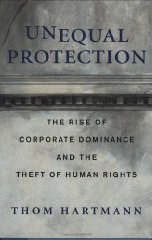 |
recommend book⇒Unequal Protection: The Rise of Corporate Dominance and the Theft of Human Rights |
| by |
Thom Hartmann |
978-1-57954-955-8 |
paperback |
|---|
| birth |
1951-05-07 age:66 |
978-1-57954-627-4 |
hardcover |
|---|
| publisher |
Rodale |
|---|
| published |
2002-10-04 |
|---|
| How corporations have taken control the government and have used terrorism as an excuse to abrogate human rights. How they have used NAFTA and the WTO to squash labour and environmental protection. |
|
| Greyed out stores probably do not have the item in stock. Try looking for it with a bookfinder. |
Book referral for The World Trade Organization: A Citizen’s Guide
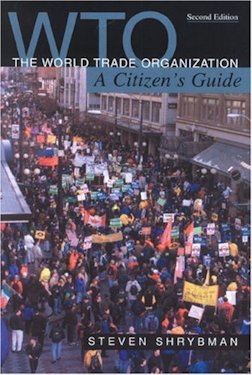 |
recommend book⇒The World Trade Organization: A Citizen’s Guide |
| by |
Steven Shrybman |
978-1-55028-735-6 |
paperback |
|---|
| publisher |
Lorimer |
|---|
| published |
2001-02-19 |
|---|
| Shrybman is an environmental lawyer who takes you by the hand explaining the WTO from scratch. You don’t need a degree in economics to understand his book. |
|
| Greyed out stores probably do not have the item in stock. Try looking for it with a bookfinder. |